
How many restrooms does a Columbus race need?
Start with runner count, then split it three ways: start chute, mid-course water stops, and finish line. A field of 3,000 runners typically wants a cluster at the start, spaced single units along the back half of the course, and a bigger bank at the finish where people linger. Standard porta potty rental units cover most of that load; the finish festival, where crowds sit still for an hour, is where you add deluxe flushable porta potties or a small restroom trailer if budget allows. ADA Standards section 213.2 requires that when single-user portable units are clustered, at least 5 percent of the group be accessible, with a minimum of one unit, so a start line with twenty standard units needs at least one ADA accessible porta potty in that row, not off to the side. For volunteers and staff working the course, OSHA 1926.51(c)(1) sets toilet ratios by headcount, and a race with 40 course marshals falls into a different tier than one with ten. If you are still sizing the event, how many porta potties do i need walks through the math per checkpoint. Races through Grandview Heights, 5.0 miles west of downtown Columbus, or out toward Bexley, 6.2 miles southeast, often split restrooms across two jurisdictions on one course, which changes delivery timing more than it changes unit count.
What does race day setup involve, and where does a temporary power pole fit in?
Course restrooms go in fast, early, and out of the way of the route, and most race organizers want everything placed the night before. A standard unit sits about 44 by 48 inches on the ground and stands roughly 92 inches tall, so even a tight sidewalk gap near a finish chute can usually take one without blocking the lane. Lighting and timing equipment at a pre-dawn start often run off a temporary power pole rather than a generator, and how to brace a temporary power pole matters more on race mornings than any other job, because wind gusts across an open finish festival can tip an unbraced pole into a crowd. The pole needs a stable base plate, guy wires or a ballasted stand rated for the load, and clearance from the restroom row so a knocked-over pole never lands where runners funnel through. Pair the temporary power pole with a light tower rental for pre-dawn starts, and keep both outside the swept path listed on your course permit. Temporary fence rental or crowd control barrier rental around the restroom bank keeps runners from bottlenecking, and a row of chain link along the finish chute does double duty holding spectators back. For water stop cleanup, a single roll-off dumpster rental at the finish festival handles cup litter and banana peels faster than bagging by hand, and a 10 yard dumpster rental usually covers a mid-size 5K.
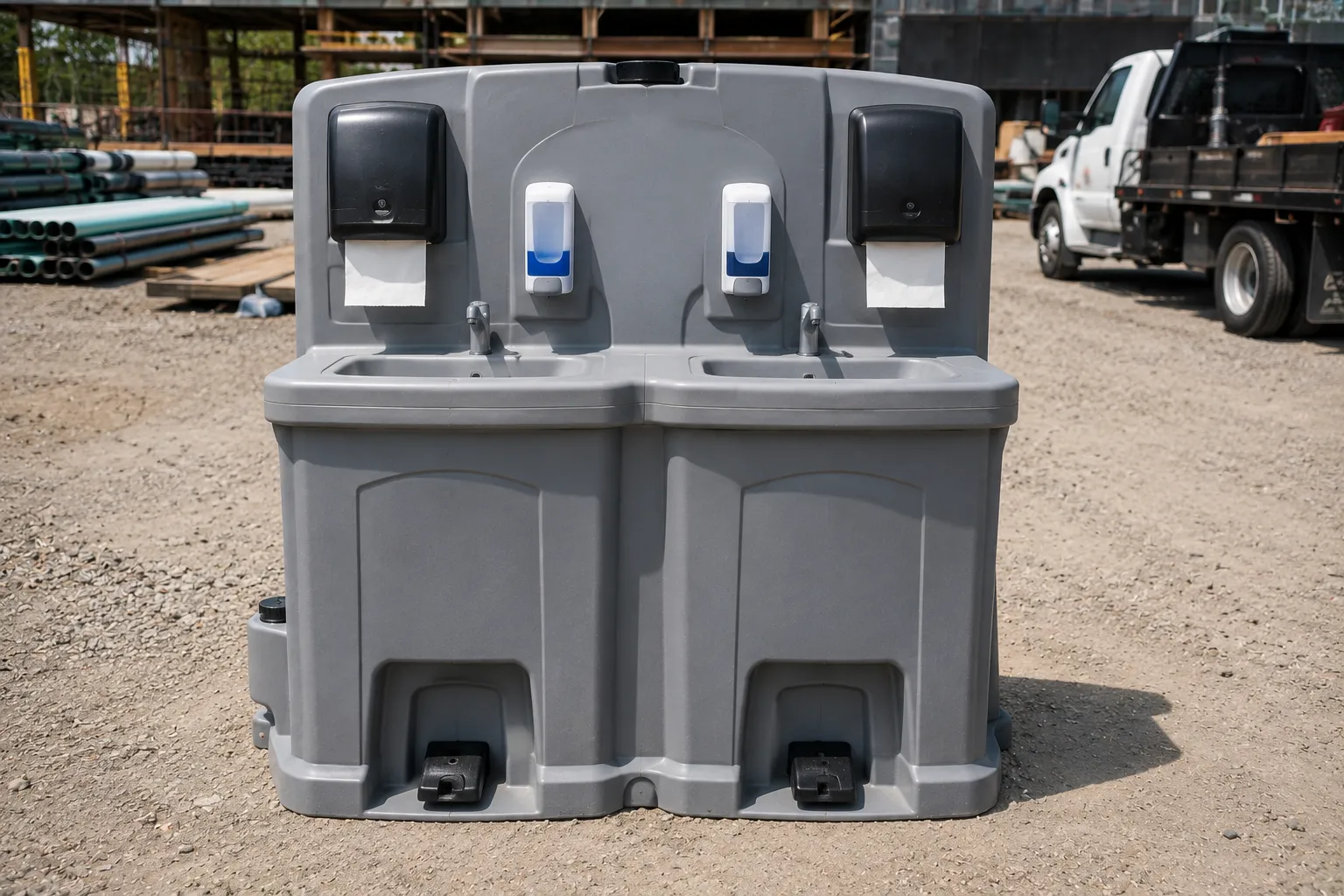
Do race restrooms need handwashing stations too?
Yes, and it is easy to skip if you are only counting toilets. Runners handling energy gels and volunteers serving food at aid stations both benefit from a handwashing station rental placed near the finish festival, and 29 CFR 1910.141(d)(2) requires washing facilities to include soap and towels or a hand drying device, since hand sanitizer alone does not satisfy that standard. A portable sink rental works well at food tents, while a simpler hand sanitizer station rental can supplement, not replace, real handwashing near restrooms. Columbus race weekends in spring and fall sit inside a stretch where the city averages 78.5 days a year with 0.10 inch of rain or more, per NOAA climate normals, so a muddy finish festival is common enough to plan for gravel or matting under handwash stations and restroom rows. Races drawing runners from Westerville, 14.2 miles north, or Reynoldsburg, 16.8 miles east, often add extra handwashing near packet pickup the day before, since that draws its own crowd separate from race day.
| unit | day | week |
|---|---|---|
| standard | $100 to $350 | $130 to $500 |
| ada | $200 to $400 | not typically rented weekly; ask for a weekend or day quote |
| deluxe | $85 to $1,200 | $150 to $290 |
Weekend race rentals, covering Saturday setup through Sunday teardown, run separately from the day and week rates above; ask for a weekend quote when you request a quote. For full pricing context across unit types, see porta potty rental cost or porta potty rental per day.
How far ahead should we book restrooms for a Columbus race?
Book as soon as the course and headcount are set, ideally 4 to 6 weeks out for a mid-size race. Weekend demand spikes in spring and fall, and popular finish-line venues fill fast. See porta potty placement guide for siting help.
Can we get restrooms placed within city right-of-way for a race?
Placement in the public right-of-way needs confirming with the City of Columbus; Chapter 903 governs occupancy permits for construction-related uses like dumpsters and PODs, but whether portable toilets fall under it is not settled. Check porta potty permit requirements.
What is an ADA accessible unit, and how many do we need?
ADA Standards section 213.2 requires at least 5 percent of a clustered group be accessible, minimum one unit. A 60 inch turning circle, per section 304.3.1, is part of that spec. See ada restroom requirements.
Do restrooms need cleaning during a multi-day race weekend?
Yes, for events spanning packet pickup through race day, service typically follows the ANSI/PSAI Z4.3 baseline of one visit per week for moderate use, though heavy race-day traffic often needs a same-day touch-up. See how often are porta potties cleaned.
Can Citywide Porta Potty handle races outside downtown Columbus?
Yes. Courses running through Upper Arlington, 6.9 miles northwest, or Whitehall, 8.6 miles east, are within normal delivery range. Check service areas for full coverage.
Next step
Get a delivery date
Tell us the address, the dates and the headcount. We size the order and confirm the route.